Railways of the Lost Atlas
or: School-night 18xx with a solo mode?
Railways of the Lost Atlas was originally on Kickstarter a couple of years ago, and at the time I was very interested; unfortunately, it didn’t include a solo mode at that time, and I knew I just couldn’t justify another 18xx game, because there was hardly enough shelf space and dust to go around for the rest of my non-soloable 18xx collection. I reluctantly passed on it.
But, as I’m subscribed on BGG to all 18xx games, I noticed when one of the designers started working on a solo mode. I also noticed when the Landmarks expansion went on Kickstarter. Again, interested, but without knowing much about the solo mode (I never bothered to actually read much of the BGG thread where it was being worked on), I passed- I can always buy a copy later, I told myself.
Now that Landmarks of the Lost Atlas crowdfunding project has been fulfilled, I noticed some more activity, specifically people showing the solo gameplay. So, I decided I would go all-in, without really knowing too much about it.
The chrome, for those with 18xx experience:
- The game actually starts with a minigame to create the map, then proceeds into the usual 18xx game structure
- The offboards are called Distant Destinations and can feature a variable (from game to game) sequence of revenues. In my game, I played with 30-60-90-30
- Tokens are called Hubs (???)
- Minors and Majors are both Incremental Capitalization
- Game structure is Stock Round (SR), Operating Round 1 (OR1), Operating Round 2 (OR2), Merger Round (MR)
- The game is played in either 4 (Short Game) or 6 (Long Game) sets of rounds, called Cycles
- Game features Minor Companies (5 share) and Major Corporations (10 share)
- OR1 and OR2 is always played, regardless of phase
- Merger Round is skipped unless phase Green or later
- In SR, you can either start an auction to open a Minor, or you can Sell-and/or-buy (in that order), or pass
- The winner of the auction gets to choose a Minor from the ones available and the winning bid goes to the company treasury. Starting Market price is half the winning bid (because you are bidding for the president’s share), rounded down to the nearest listed Market value on the board
- Majors are only created by Merging in the Merging Round
- Each Minor has an assigned home (except for one, which gets to choose any “basic city” as its home)
- Each Minor has a special ability
- When two Minors merge, they create a new Major that retains the special ability of the two Minors
- Mergers work like 18Ireland- both presidents must agree (likely with yourself), treasuries and trains combine, market price is average of the two Minors, rounded down to the nearest value shown on the Market
- Companies can close at value 0.
- Player bankruptcy eliminates the player but does not end the game.
- You can run a train as a “Local”, running it for 1 stop at a Hub
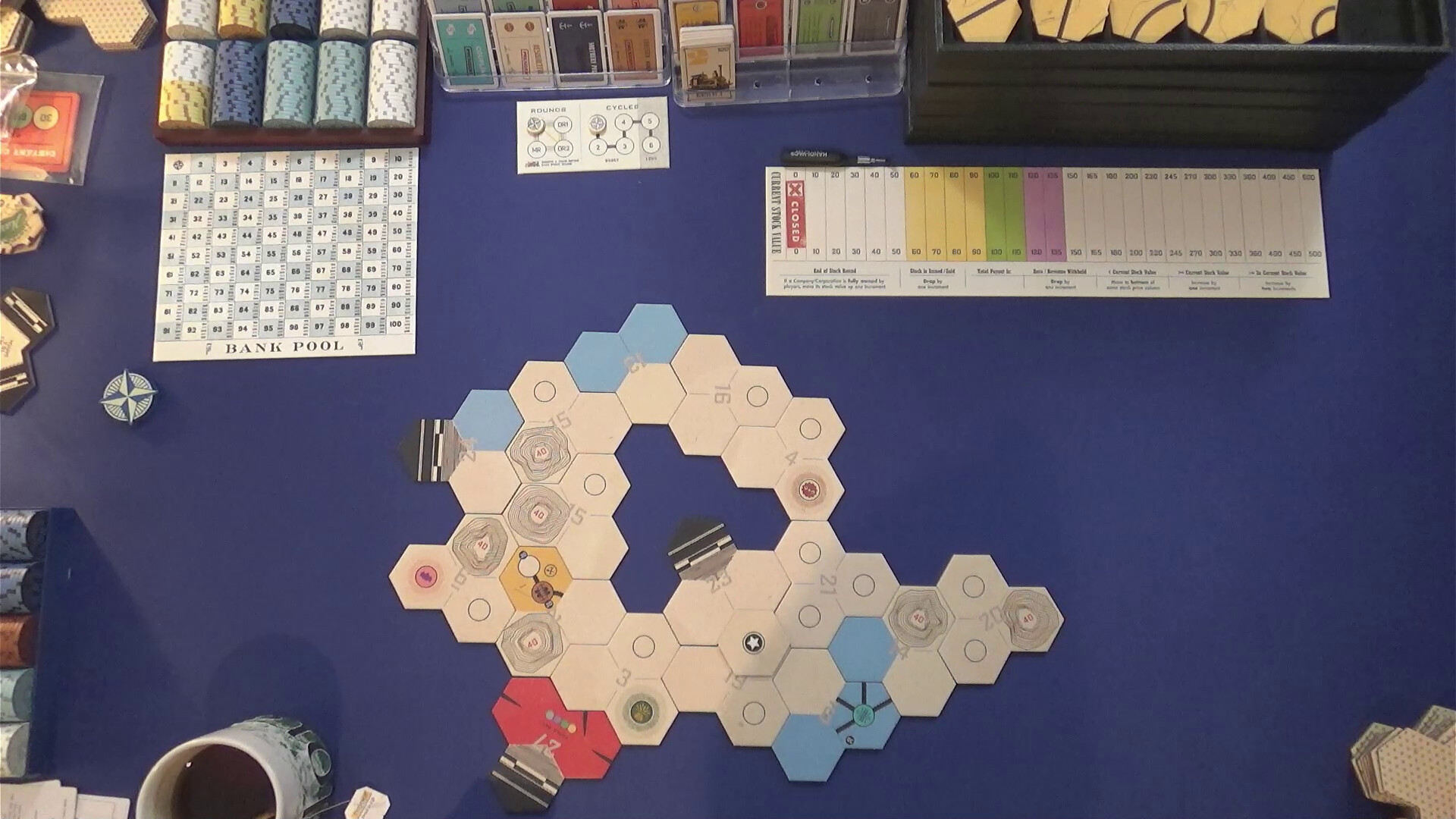
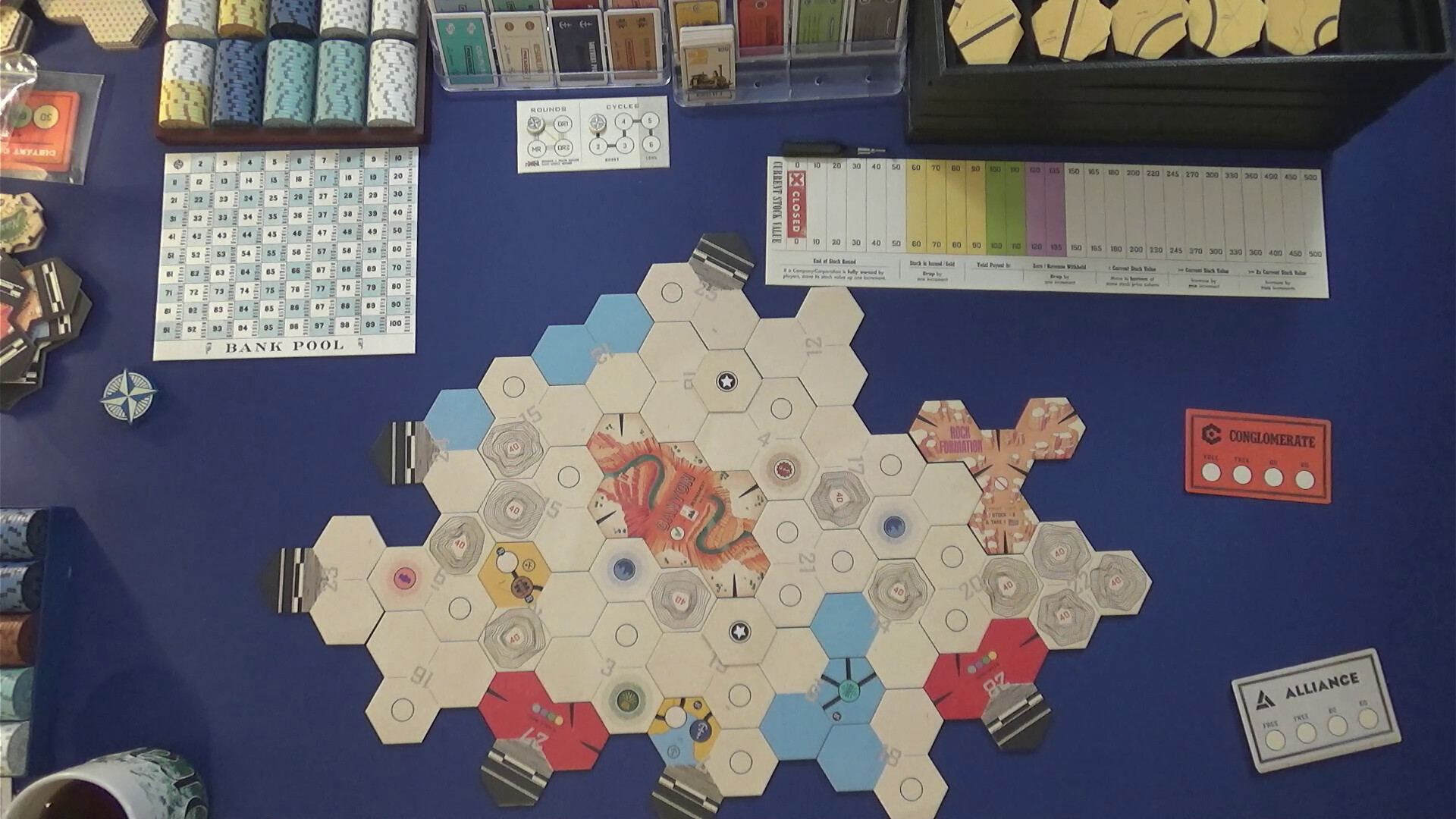
Railways of the Lost Atlas comes without a fixed board and, instead, features modular 3-hex map tiles that you assemble into a custom map each game (when not using a pre-determined map, I guess).
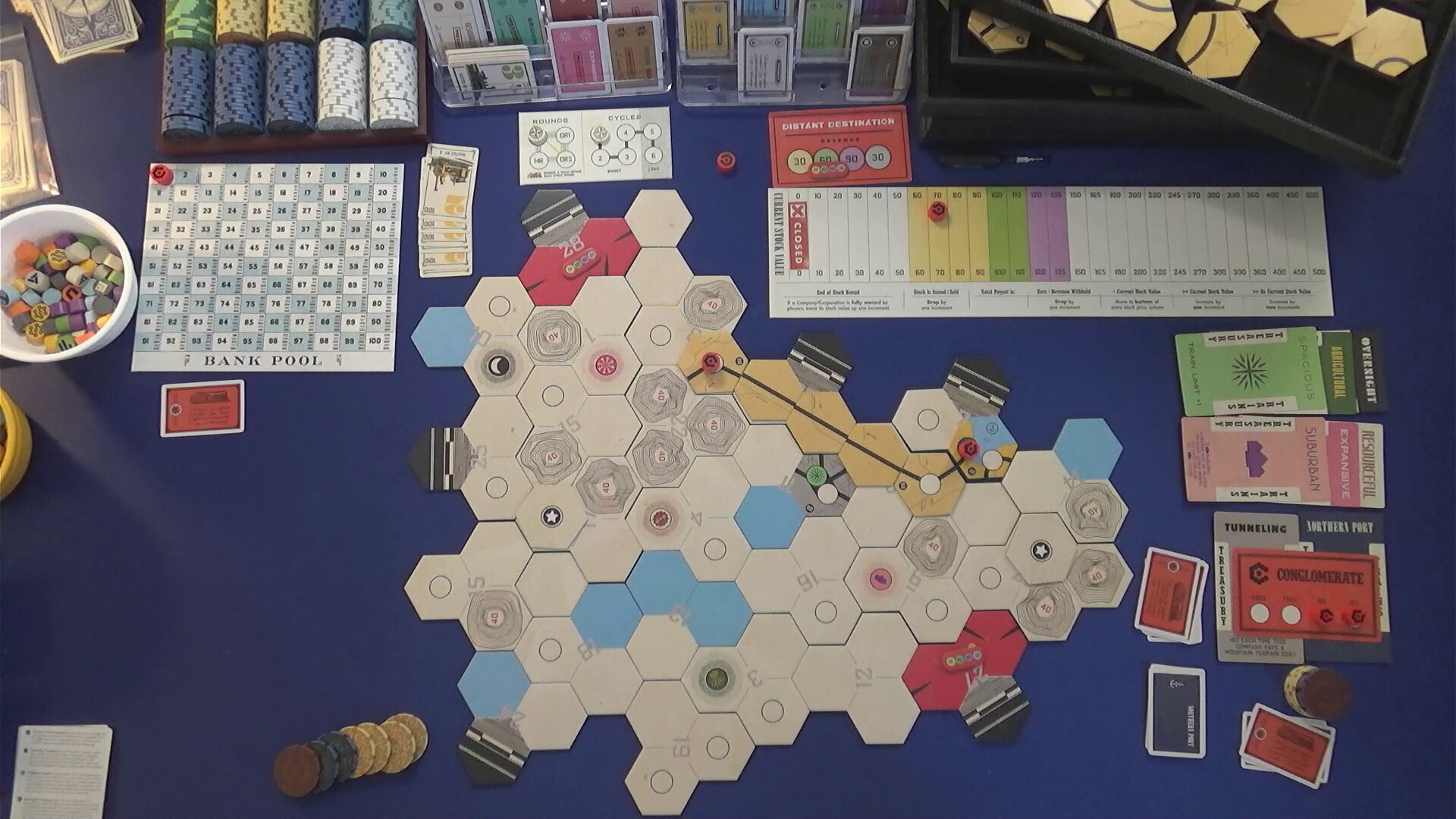
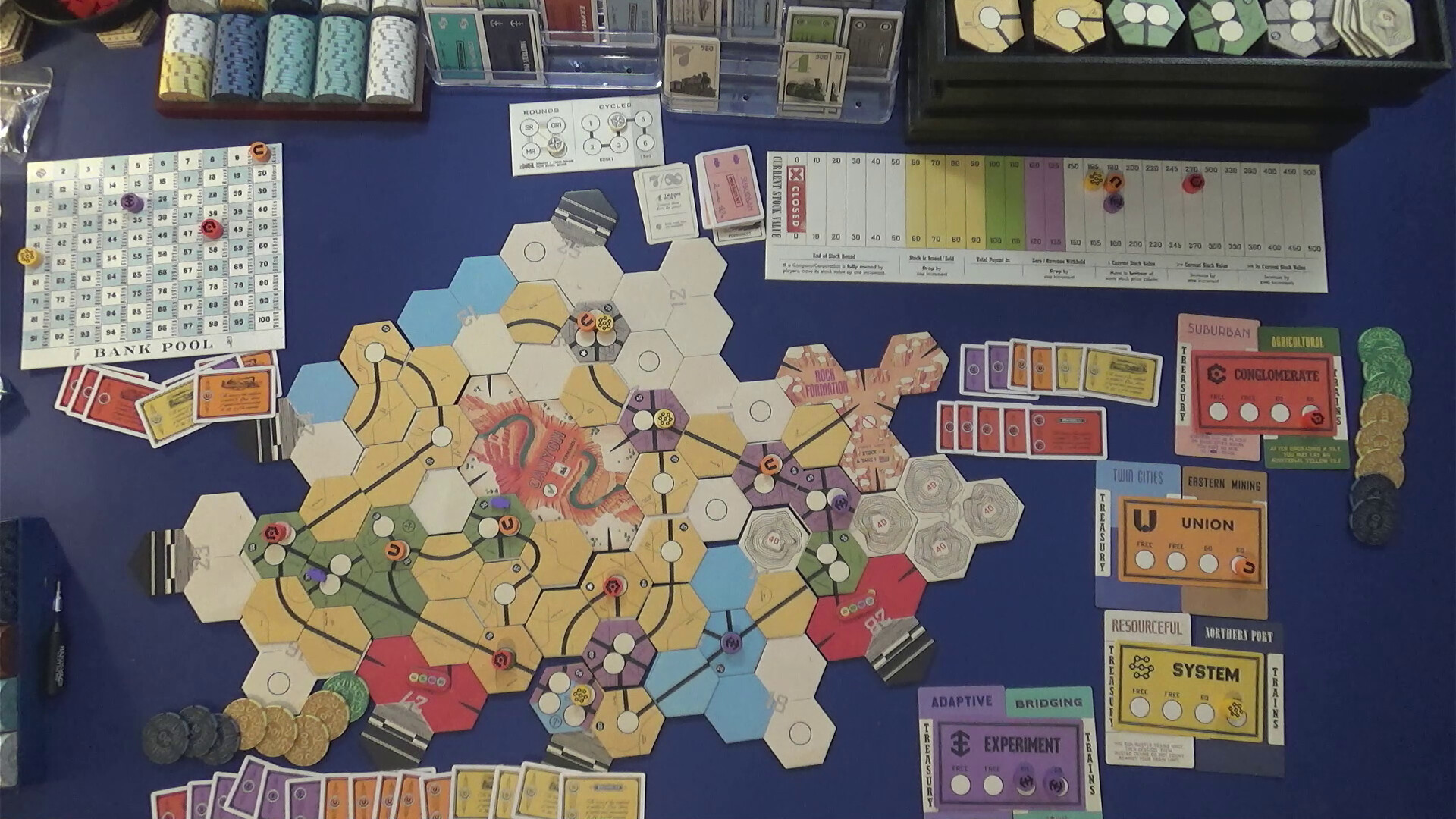
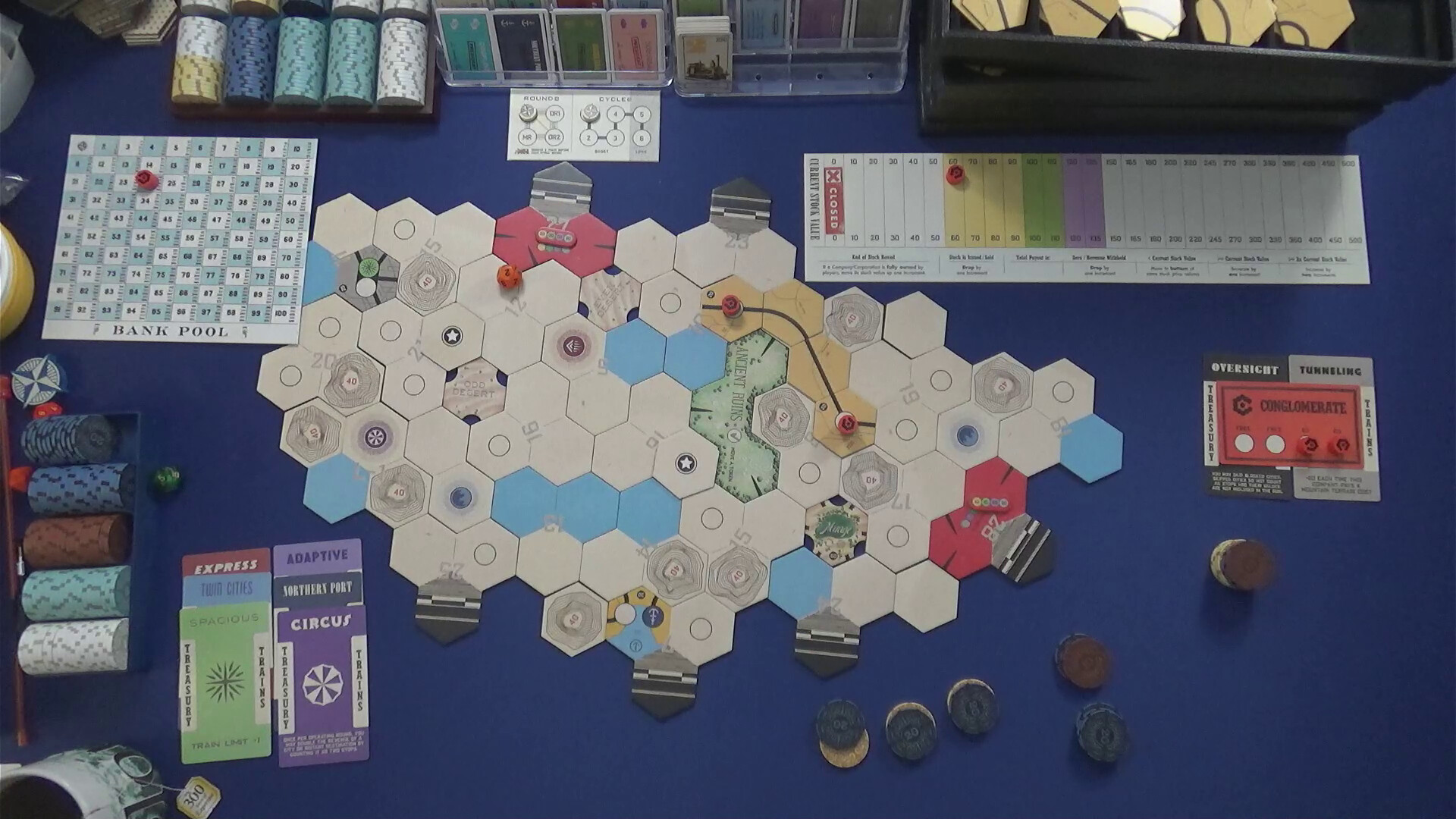
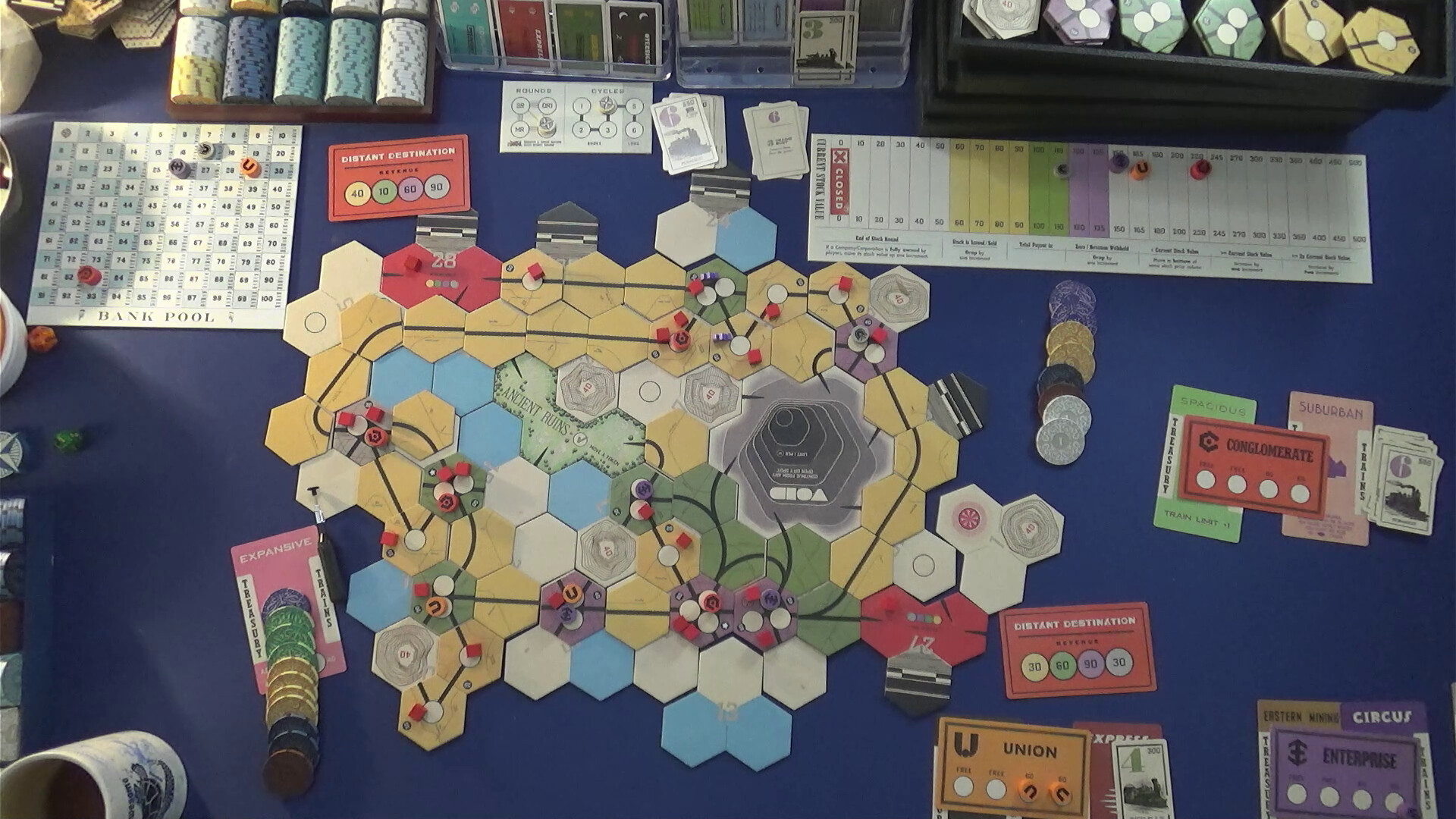
Here’s mine from my first solo playthrough:
You can see some track already on the board: the solo bot is created by randomly selecting one of the Minor companies available (in this case, Tunneling) and then the player chooses one of the remaining Minor companies to join with the first to create the Major that the solo AI will control for the game. You then create the most efficient path between the companies, picking up revenue locations along the way if possible. The initial revenue along the connected route will determine the “difficulty”. In this case, it was 70, which made this “medium” difficulty.
The solo bot uses a deck of its minors as an action deck; a normal share triggers a normal action, while a president’s share triggers a special action. The special action is different per minor. Most of them feature the “breakthrough” special action, which allows the bot to do a tile upgrade to bridge into a player-created network. Neither of the minors used here (Tunnel, Northern Port) have breakthrough, so that was not something I had to deal with.
In fact, I was able to shoulder out the AI from my network for most of the game. I decided to start Spacious (printed grey hex, north-easternish) as well as the Suburban (pink icon to the SE of Spacious). Unfortunately, I intentionally stayed in Yellow through the end of OR2 of the first cycle to avoid the AI picking up the Resourceful Minor (center of map, brown-ish color), because I wished to start that Minor next. In a Merger Round, the AI will absorb an unstarted Minor that it is attached to. In my game, I managed to fend off that from ever happening, but probably to my detriment, because I wasn’t pushing trains like I probably should have.
Later, after starting both Expansive and Resourceful, I merged both neighboring pairs into two Majors. I probably should have merged Suburban to Resourceful and Spacious to Expansive, but I don’t think it mattered that much.
I made the mistake of starting a 5th Minor, Agricultural. That was a huge mistake. If not pushing the trains was my biggest mistake, opening a 5th minor was second (and I might even waffle on swapping those two). Agricultural, south side of the board was running for 100 at the end of the game, unable to break out of it’s southern spur into the broader network (because Minors don’t have Hub tokens to put down (except Expansive))
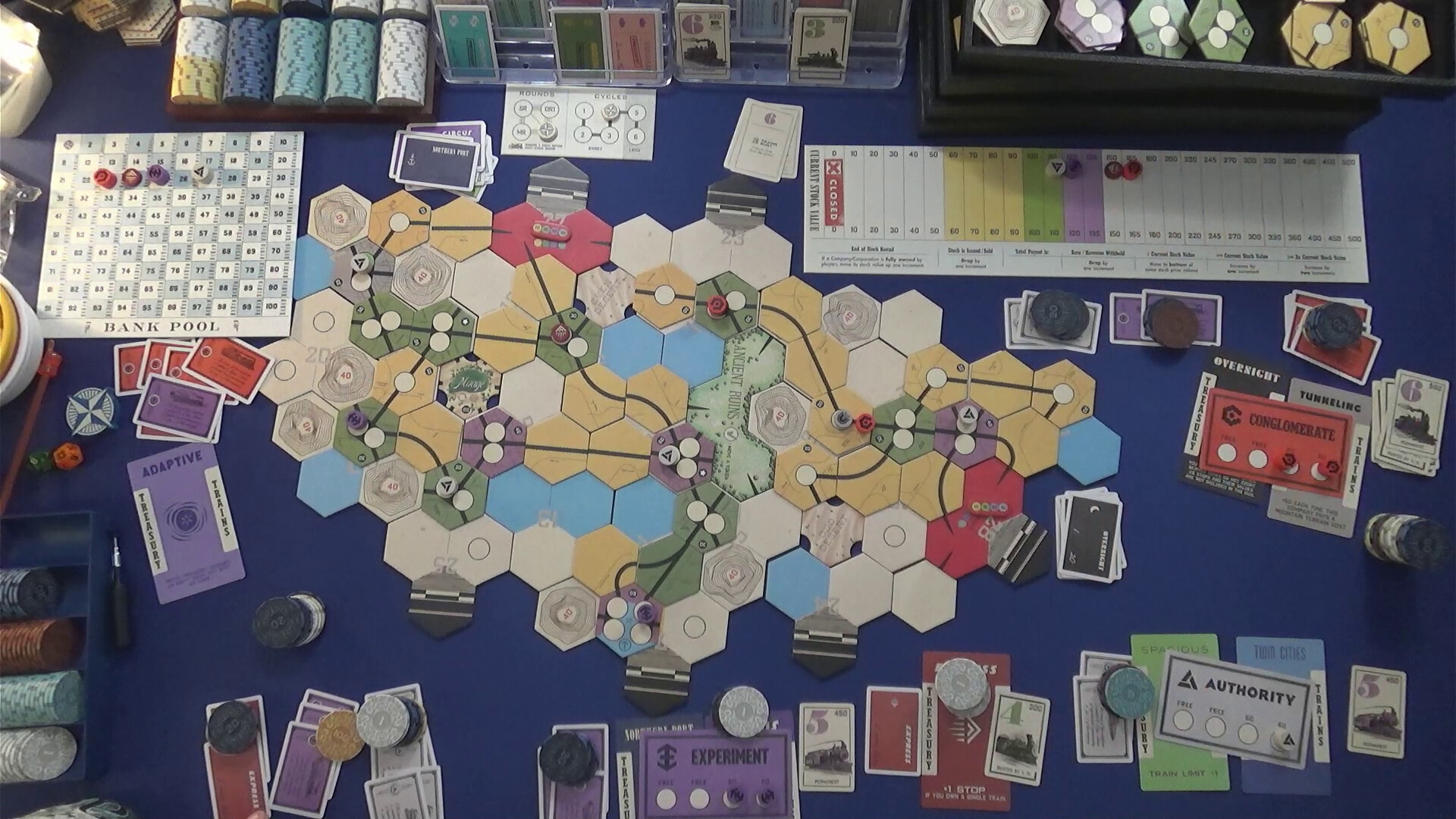
(end of game)
Four cycles is so short (8 ORs). In the solo game, the AI becomes the train export (once per OR) rather than the end of OR2 triggering one. I somehow managed to have Permanent 3 trains, and that was likely the crux of my issue. I lost, 2556 to 3444.
I’m definitely going to play with Railways of the Lost Atlas: Landmarks of the Lost Atlas expansion next. It’s a modular expansion, and only one of the modules can’t be used in solo play. It adds new Minors, the eponymous Landmarks (tiles with special abilities), an option to launch a Minor direct to Major, and probably something else I’m forgetting.

 ) as well as the open side of the Northern Port home, giving it a base revenue of 90- this also meant that it was running first in every OR round.


 We played 3 missions of our Bomb Busters box I had brought along. Her’s is much further along and I wanted something cooperative I knew ahead of time we all liked. I think it plays best with 4 but 3 is a pretty good number, too. And we had some good moments and fun deductions.