Played Oath:Chronicles of Empire and Exile yesterday. And what a beast it is. There’s a few different ways to win, depending on your role in the game. The Chancellor starts as the ruler, but the other players (as Exiles) are trying to win in their own ways. There’s a full one round walkthrough of a four player game in the manual, which is excellent, more games should do it. You just follow the setup in the book, and sets of cards and location tiles are added in a particular order. The walkthrough covers all the major actions possible, and also explains why a player would take those actions.
It seems like the game shouldn’t take long. There are only eight rounds, and the game could finish in five. And on each player turn, you may only have four or five actions. Every major actions cost supply points, so you’re limited by that.
The major actions are Search (get new cards to play), Muster (add warbands of your colour), Trade (get one of the two currencies, either favour or secrets), Recover (take a relic at your site), Campaign (fight!), and Travel (uhh, you travel around). Most of the actions are pretty straightforward. The tricky one is Campaign, because you can attack a number of things belonging to another player. You can target sites that are at, relics they own, and their actual pawn and favour. Combat is dice based, and can easily end with both players losing warbands.
There are multiple ways to win. Each game has a different goal. The first game uses The Oathkeeper of Supremacy, which means you win if you rule the most sites. The Chancellor starts with the Oathkeeper title. But if another player rules more sites, they take the Oathkeeper title. If an Exile player starts their turn with the Oathkeeper title, they flip it and now they are The Usurper. If they start a turn as The Usurper, then they win.
Exile players can also win by drawing vision cards from the deck, each with it’s own win condition.
As well as Exiles, a player can become a Citizen, which is an ally to the Chancellor, but they can win on their own condition.
It’s a pretty absorbing game. I tried to explain the main actions, then we went thru the playthrough, and then played a couple of rounds ourselves. We didn’t finish the game, so much to think about. But we’re keen to get back into it next week, and I think it will run smoothly.
Master Word first play, pretty simple word game. One player shows the card with it’s hint (like food, or animal), and then the other players write hints. But the seeker can only tell the others how many of their clues are correct, not which clue. Interesting enough for a quick game.
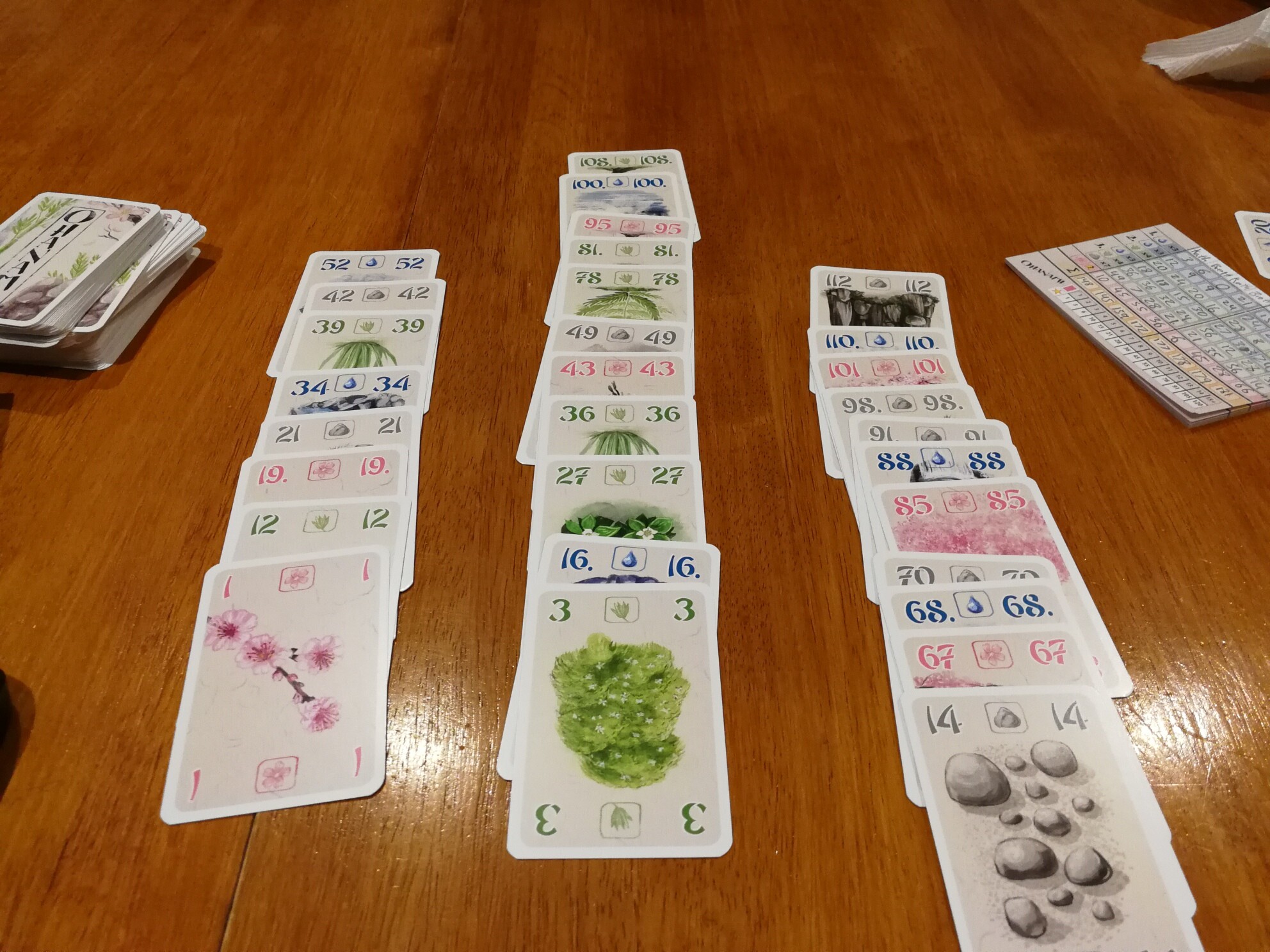
Fantasy Realms , first play, cool little card game, which I hadn’t heard of before it was nominated for the Kennerspiel Des Jahres. And if I saw it in a shop, I’d probably just pass it by. The generic title doesn’t help, and it’s a small, unassuming box. And inside is only 53 cards. The gameplay couldn’t be any easier. Pick up a card from either the discard pile or the deck, add it to your hand, then discard a card. You’re trying to get points, obviously. A card has a numeric value, and may also have a bonus or penalty section. And you’re trying to make combos. A card might be worth 30 points, but only if you can pair it with another specific card (or card suit). A card might have a penalty and give negative points, but another card might “blank” that penalty. There’s more to think about than you think. Do you hang onto a card that is only worth points with another card, which you keep drawing blind to find. Maybe as soon as you discard it, another player will swoop on it. Discards are all face up, and played separately on the table, so you can take any card. The game ends when there are ten cards in the discard. Which doesn’t take long at all. More fun than we thought initially, we played two games in a row. Nice little filler.
Switch & Signal , we resisted the urge to make it easier, we’ve only played it twice (and lost both times). And it looked like things were going the same way again. There were only five driving instruction cards remaining, and when that runs out, it’s game over. And we still needed to get two yellow goods to the port city. We had our fastest trains (black) on the job. And we won! With only one card left. Good effort I thought, I had almost given up.
Cascadia , finished up with this, an easy game to play. Although one player had forgotten that you could use a nature token to wipe any number of wildlife tokens. I don’t think we’ve ever done it. We are still using the basic A cards for scoring, since we know them pretty well. And the scores could not have been much closer, 89/88/88. I was the winner, so I was happy about that.
 But I suspect it will get a few more solo plays in the meantime.
 . We felt there was maybe a touch of bad luck with the relentless drawing of Sand and Wetlands and the start and I thought I could improve with Trickster so we just went again. We did better! We lost all the blight on the 8th invader card. So we lost twice as well
  I think we struggled with 2 slow spirits and I still struggled with Trickster. Plus the step up to Scotland 6 from 5 is a skew in strategy. It’s the only level that hits the inland rather than the coast so the management of the escalation is noticeably tougher. I think I need to learn more about Scotland 6 and Grinning Trickster separately before bringing them together again. It would be disappointing to beat a level 6 on the first attempt.
  Scotland takes less than the months England 6 took to beat.
 Harmless on the outside…