“We won’t tell you where the courier is, but the company who will come after us…”
3 Likes
Ahh - Heisenburg XOR Delivery Services Inc.
We know where your parcel is, when it will be delivered, or how much it weighs.
10 Likes
(Our instant hot water dispenser has broken)
“Guess I’ll just heat my water in the microwave like a goshdarn caveman.”
6 Likes
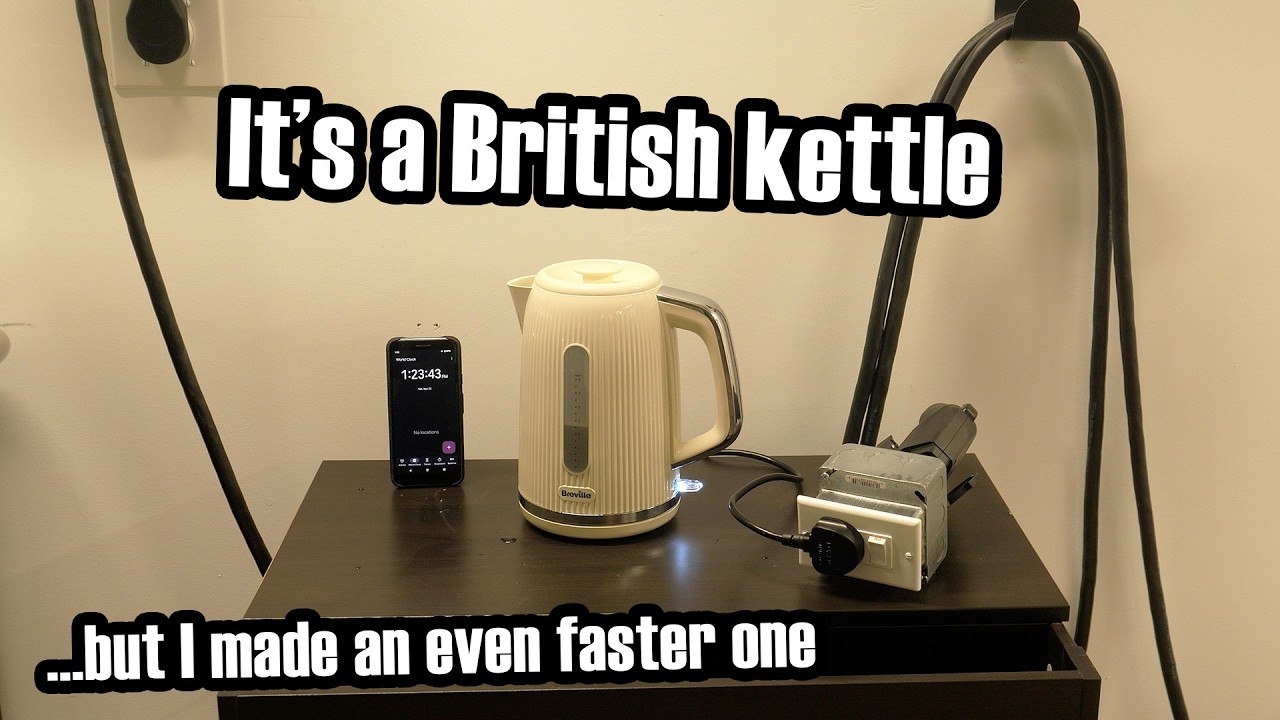
Cue all the Brits being baffled at your lack of an electric kettle.
9 Likes
The sins that are committed in the name of 110V mains power.
6 Likes
Oh we have one. But it’s even slower (and I can’t get the water to ~170°, it’s all or nothing).
The Taiwanese also need an electric kettle - and it must be specific brands not made in China. Every house has one or you lose your Taiwan card.
5 Likes
Our hot water tap was broken today.
The choice was between a crusty kettle or walking to a different kitchen. I chose the latter and a flight of stairs.
9 Likes
I used to have a really great electric kettle that had about six different temperature settings.
When the buttons stopped working because they were gunked up from years of use, I discovered that the manufacturer had ceased to make any models with temperature settings. 
5 Likes
Same. Technically, we still have the old one, but it has a bunch of scale buildup, so when Aldi had a kettle in their shame, we bought a new one that only has one setting: “On”. Honestly, I never used the various temperature settings and much prefer the on-lever rather than the push button on the old one.
4 Likes
If you want to talk about sins of domestic wiring, UK practice is pretty high on the list. Probably tops, if you ignore places where “safety” and “standards” are quaint notions. We can start with the insanity of ring circuits supplying 6kW to a socket, but expecting the plug to limit consumption. Or maybe ring circuits in general. Or centralized RCD so a fault takes out everything in the house, and because it’s centralized, to keep from having constant nuisance tripping, the fault current has to be so high it can still kill you before it trips. (That might be an unfair jab, the UK requires RCD because their wiring is inherently unsafe. They’re to protect the building, not the occupants. US GFCI are about life safety, and we use sane wiring practices to protect structures.) UK wiring was done to save wire, which made rebuilding after the war faster and cheaper, and the expected increase in house fires was considered an acceptable trade off.
Also point of order: the US doesn’t have 110V anywhere, though some places did before the 1930s. the US and Canada have 240V mains[1], supplied as center-tapped split phase, meaning two conductors 240V to each other, but 120V to ground. For most domestic use, only one of the phase conductors is present, along with a grounded neutral for the return current, but 240 is supplied to loads that require it. There’s no reason we can’t have a 240 receptacle in the kitchen for an electric kettle, other than people would think you batty. (I knew someone who did that. Not surprisingly, he was a brit, and batty.)
[1] except where buildings get 3-phase power, but that’s uncommon except in large apartment buildings.
6 Likes
I used them when I was making green tea or cocoa for the kids.
4 Likes
Ours is a Cuisinart. They appear to still make temperature control kettles
amazon.com/Cuisinart-CPK-17-PerfecTemp-1-7-Liter-Stainless/dp/B003KYSLNQ
3 Likes
I was briefly ecstatic until I looked at the kettle in question and immediately made a list of things I hate. 


Edit: But the pull may be too strong….
6 Likes
Fortunately, oven chips have been invented since the war, so it probably balances out… although we have stopped putting asbestos in everything, soooo 
5 Likes
there are others available. they’re not terribly common, but tea weirdos like them. a previous job had a number of such people in the office, so there were two zojirushi electric water heating appliances. One was a kettle, which had temperature settings, but was mostly used to boil water for the coffee weirdos; the other was a thing that held a gallon or so of water, and had a program – it boiled water in the morning, then held it fairly hot until about lunch time, when it boiled it again and held it at different, lower temperature. I don’t remember the details, because I never touched it, to avoid the ire of the tea people.
5 Likes
9 Likes
This reminds me of a 1995 Dave Barry article where some engineers tried to barbecue really, really fast, and progressed from using not compressed air, no no, compressed oxygen, to eventually… liquid oxygen.
5 Likes
Some years ago (early 2000s?) I was chatting with a fireman who said that the three things that had made his job easier were the end of smoking in bed, the end of chip pans, and compulsory electrical safety inspections when a house is sold.
8 Likes
Sorry @yashima, the topic of the week is now electric kettles and building codes.
11 Likes
I just had the thought sequence:
- Plumber
- Because plumbum = “lead” in Latin
- So in English, Plumber would be Leader
- We should put a Plumber in charge
What is wrong with me.
6 Likes