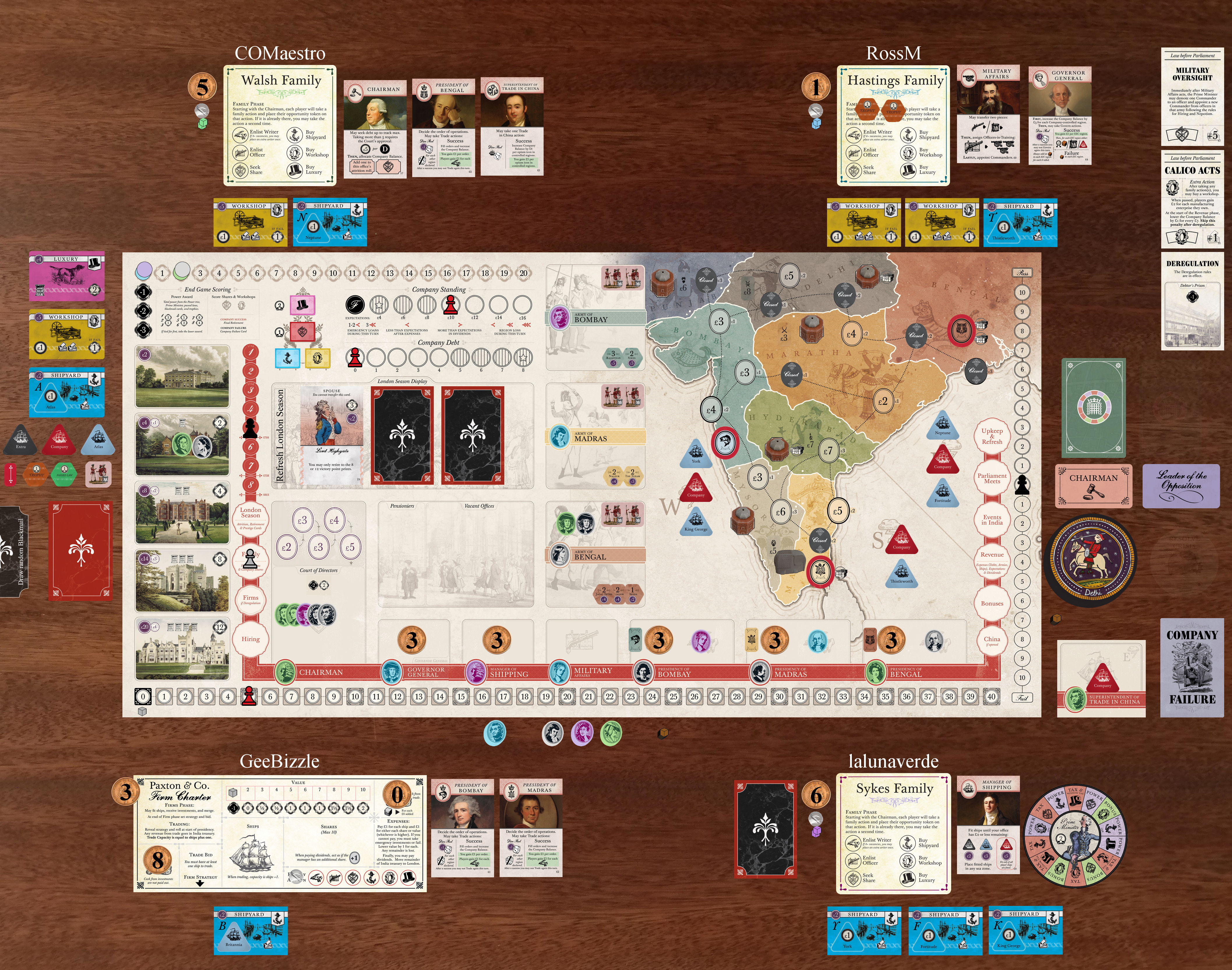
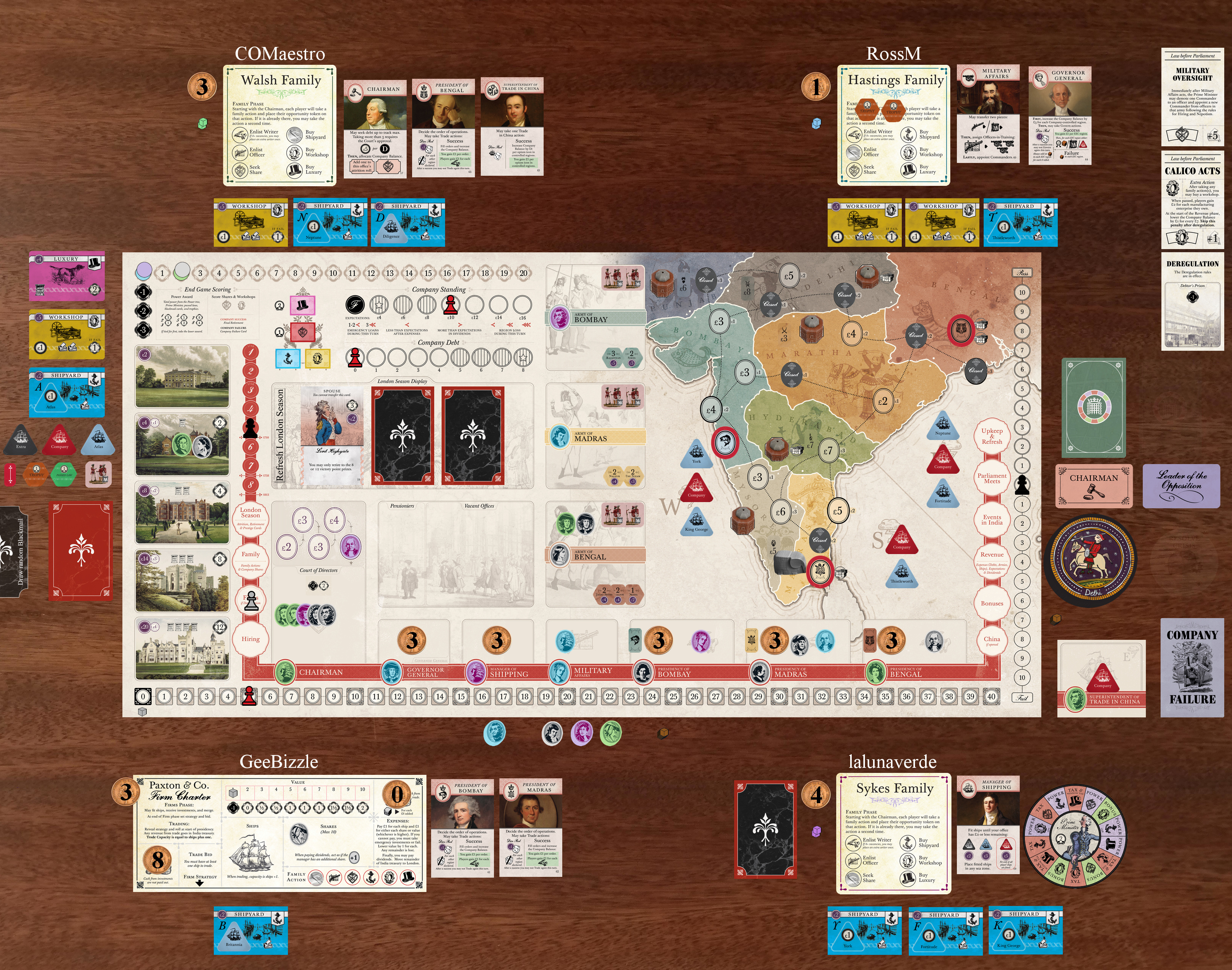
This is the setup for the 1813 game. Some explanation and overview of the big differences between this and the 1710 game will be coming up later.
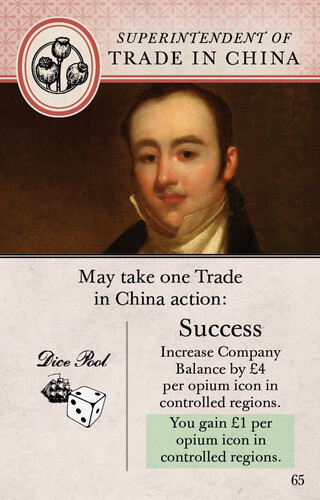
This smarmy-looking guy is in charge of the opium trade to China.
As the card says, the number of dice you roll is simply the number of ships dedicated to China trade (currently 1). No other funding is required. On success, £4 per opium (crate) symbol in Company-controlled regions (currently 3). Ships trading with China are considered to be in the East sea for storms.
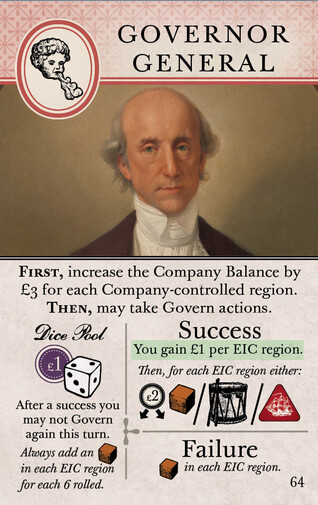
This guy entirely replaces the old Governor system AND the old Director of Trade. There are no regional governors in this game, and no Director of Trade, meaning there is NO WAY TO MOVE SHIPS. As the card says, £3 per Company region, then may spend money from the Governor treasury to roll. Add unrest to Company regions for every 6 rolled, regardless of the result. On success, get £1 for the family for each Company region, then for each Company region, add £2 to Company or any other treasury AND add an unrest to any one Company region, OR add a regiment to any army, OR add a Company ship to any sea zone.

The game starts with these laws in play. Military Oversight does what it says. Calico Acts just gives the optional extra action of buying a Workshop, you can ignore the rest. The debtor’s prison will be explained when I go over Firms, coming up next.
1 Like
Firms.
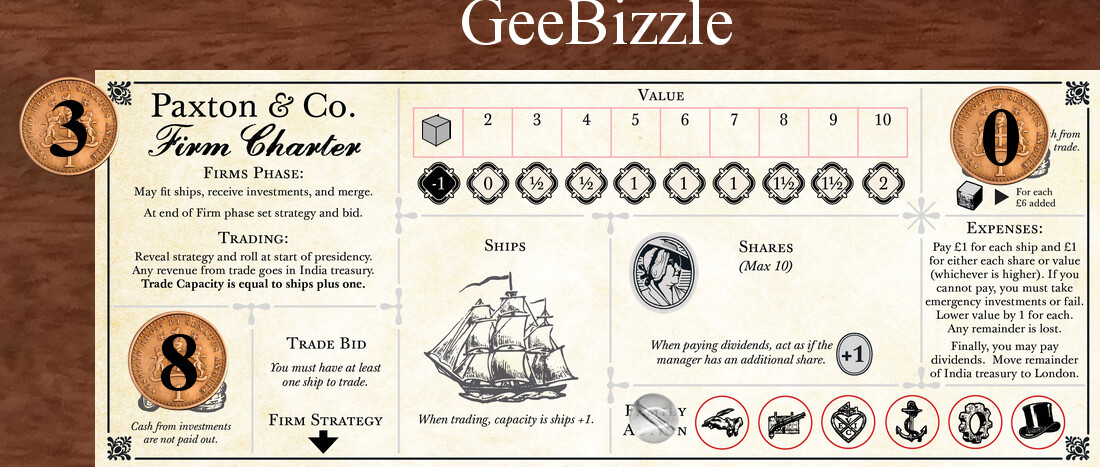
When you have a firm, you have 3 separate treasuries, the regular family one, works as normal, the London treasury, used to pay for ships, and the India Treasury, which holds revenue and is used to pay dividends. Money is not freely transferable between any of these, with the exception that money from the India treasury moves to the London treasury after expenses, and that expenses may be paid from either firm treasury.
When you have a share in any firm, you get a “special retirement” opportunity in the London phase and at a company success game end, where you can spend family cash up to the value of the highest dividend most recently paid out by a firm you have a share in to retire a family member from your supply - you don’t lose an office doing this.
At the end of the game, for every share in a firm you have, you get the VP of that firm’s share value - the “value” track above.
To form a new firm, you need one of the following:
a workshop, which gets flipped to the invested side, losing the £1 income and the 1 VP on company failure
OR
a company share that wasn’t gained this turn, when the Company debt and standing are not in the hatched spaces, i.e., when the Company is doing well. You lose the share.
You start a firm with 1 share and £5 in the London treasury.
You can invest in someone else’s firm, with the same requirements as forming a new firm, placing 1 share in the firm and £5 in the London treasury.
There’s a 10 share limit on firms. Further investment is possible, but no shares would be added.
Only privately owned ships can be added to a firm, costing £3 to fit as usual, but paid from the London treasury and only with the shipyard owner’s consent. You can also buy ships from the Company, at £3 a ship or £2 if fatigued. Money goes to the Shipping office.
If a majority of shareholders agree to a hostile takeover, you can take control of someone else’s firm - you simply swap ownership and become the new firm owner.
If ALL shareholders agree to a merger, multiple firms can become one - the one with the highest value - everything that was in the other firms is added to the highest value firm.
Firms operate in competition with the Company. After investments etc. are done, a firm manager must secretly select one of the following strategies:
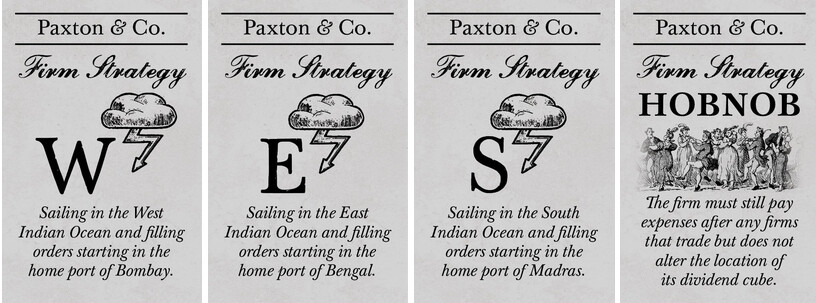
and secretly tell me how much money they want to spend (which = dice rolled)
The Hobnob strategy means no trading, but keeps the dividend marker where it is, meaning the value for the special retirement does not change.
When it’s the turn of the Presidency associated with a chosen strategy, the strategy is revealed and the dice are rolled. If successful, then number of ships minus the number of successes is the firm’s “initiative”. When the Presidency trades, the Presidency also calculates initiative in the same way.
Whoever has the lowest value for initiative trades first, filling orders. Firms fill ships + 1 orders. Whoever comes later CAN fill the same orders, but only gets the lower value (halved, round down) for each order - the little number off to the right.
Firm value goes up by 1 for each multiple of £6 traded.
Firm expenses are £1 for every ship, £1 for every share OR £value of firm, whichever is higher.
A firm that cannot pay expenses is dissolved, all shares go to debtors prison (-1 VP), ships back to shipyard. Emergency investments or mergers may be made at this time to prevent dissolution.
Firm dividends are paid from the India treasury and £1 per share + £1 for manager. Shareholders may opt to pass on their share of dividends.
Phew, I think that’s everything?
1 Like
I will of course field questions, but otherwise it’s @COMaestro as Chairman for family action, then clockwise (please ping next player as you go).
- We have full control of all 3 starting areas?
- Which was is the elephant pointing?
Yes.
From Mysore to Madras.

For reference, the elephant has a kind of quilt on its back. I might change out the graphic for something less like a grey blob, but this is faithful to the physical components for now. It will always be pointing from a non-Company region to another region, or be entirely within a Company region (indicating an impending rebellion). So even if you can’t easily tell which way it is facing, in this case you can deduce that it must be pointing from Mysore to Madras.
EDIT:

Replaced it with a clearer image.
2 Likes
Bengal does not have any open trading spots, despite it being company controlled? How are those spots opened?
Since there’s no director of trade, the only way is to deploy there. (Sidenotes: minimum loot from deploy is one pound each commander and officer. This is also a way to clear unrest, as is successful defence against a rebellion.)
Okay, family action is to build a shipyard. And I will do the bonus to buy a workshop.
@RossM is up next.
You can’t afford both: you have £5, a shipyard is £2, and a workshop is £5. (Costs are purple, income is white.)
Oh nevermind the workshop then. Didn’t realize they were that pricey.
Let’s get an officer. Can’t afford a workshop
@lalunaverde up next
Company share
@GeeBizzle 's turn
When someone doesn’t specify which spot on the stock exchange track they are paying for, I’m going to assume cheapest available, but please do specify.
(Oh, and although I didn’t mention it in my “what’s different” overview, please note that company shares are worth ±2 VP in final scoring.)
Ah i was gonna say £2. I forgot
1 Like
A writer in Madras please.
Onto the firms phase.
Any player in any order may make firm investments:
Form a firm
Invest in a firm
Acquire ships as a firm
(Hostile takeovers and mergers aren’t relevant right now)
@COMaestro @lalunaverde @RossM @GeeBizzle
You are all currently capable of doing at least one of these things, so even if you don’t want to do anything, you need to say as much.
Pass says @RossM
Pass for me