When I was running GURPS Torg it became very apparent that the published Torg adventures had simply not considered the possibility of PCs having on-tap access to flight. Even though this was an ability several of the standard characters had in the original system.
There are many non-fiction and fiction accounts of harrowing journeys with little or no human opposition. What are they doing right?
Yes, but it’s very noticeable that “feels reasonably confident with explosives” is a big factor for that specific sort of criminal.
A standard post-WWII stereotype is the guy who was a big hero in the war and (a) really doesn’t want to talk about it or (b) has realised nothing that exciting is ever going to happen to him again and goes to the bad, thrill-seeking etc.
I’ve said before, certainly to you, maybe on this very podcast, that Rabbit’s Foot, my character in @lordof1’s Masks ot Nyarlathotep game, came out of thinking that what classic 1920s CoC hardly ever does is consider the impact of the Great War on basically everyone who was alive (and in a relevant nation) at the time. Who are these people who are finding monsters, and what were they doing ten years back?
Well there’s Real World ‘how animals see in the dark’ and then there’s fantasy ‘better than night vision gear with photomultipliers and an infra-red torch thrown in’. Maybe only allow the former?
One of the BBC Natural History Unit’s regular cameramen (Owen Newman IIRC) observed that animals in the Serengeti could see fine if there was moonlight or starlight, but if it was completely overcast they were useless. He saw (thru night-vision camera) a leopard walk smack into an antelope and both animals got the fright of their lives! There’s a reason bats use echolocation and lots of burrowing mammals have big whiskers.
Those people are not making bloody dice rolls, for a start. If they know how to start a fire or weave a rabbit snare out of grass, or think of an ingenious way to get across a raging river, then the book describes their cleverness and/or ingenuity, which is interesting to read. It doesn’t boil down to…
Player: I do [insert clever thing the player once saw in a movie or on a Ray Mears programme] to light a fire.
GM: Okay you can have +1 to Survival.
Player: Oh bugger, I failed.
GM: Well, then you have no fire and lose 3 hit points during the night due to the cold.
Player: Mutter, grumble, moan.
I also don’t think I’ve ever been in a wilderness survival scenario where the characters had to make any hard choices of what to use their resources for. Stay here a day and use you last bar of Kendall Mint Cake to bait a trap for mountain goats? Or keep it to eat as you continue down the mountain? And then there’s Real Person decisions versus PC decisions. I recall Andy McNab writing in The One That Got Away, that at one point he threw away his rifle because it was empty and heavy, and therefore was a liability. But a PC throwing away an expensive firearm?!? God forbid!
Then there’s the probability thing, which is most apparent when you get asked to make the SAME dice roll again and again and again. So I’ve got 90% in Survival (Desert) but you want me to roll 6 times in a row.
The probability of me making all 6 rolls is: 0.9 x 0.9 x 0.9 x 0.9 x 0.9 x 0.9 = 0.53 = 53%.
That sequence of repeated rolls just tells me you want me to fail! (Or don’t understand probability)
This is done, in part, to maintain a wall between player knowledge and character knowledge.
However, once it is established that a character knows how to light a fire (by making a successful roll), then future rolls to light a fire shouldn’t be necessary (unless the circumstances made it an iffy proposition).
Yeah but the trouble is that in many RPG systems, your character background might be that you are Ray Mears/Bear Grylls and have a Nobel Prize in lighting fires, but you only have 60% in Survival. Because RPG systems don’t want PCs with skills of 99.99% in the stuff they are good at.
For instance, if RPG doctors had the skill levels of PC doctors in some games I’ve played, they’d regularly be diagnosing measles as acne and accidentally killing about 1 patient a day.
There’s also the question of what a “normal” difficulty roll represents. It’s very easy to assume in BRP that you roll your % to do a thing; but usually this is meant to be “doing a mildly challenging thing in distracting conditions”. GURPS explicitly gives a +4 to normal people doing normal things, like the commute to work; that still puts it at a 13+ for Dead Average Person with one point in the skill, 84%, which really isn’t high enough. (41% for a week. 3% for a month.) Piloting has its own special “double fumble” roll to account for this.
I think my approach (whatever system I’m running, and I’m trying to find ways to canonicalise this into the rules I’m working on) would be something like: if it’s what you trained to do the way you trained to do it, don’t even bother to roll or have a huge bonus. If you’re doing it in adverse conditions, play it out once so that the character can show how awesome they are, but there’s no point in playing it out again unless the conditions change.
A different approach that I also use is to use to the die roll not as a pass/fail determination but as a descriptor of how well you passed. For example, if lighting a fire, a failed roll might mean that you used up more of your fire starter than normal or maybe it goes out early or you accidentally summoned a fire sprite. Whatever works. What I try not to do is have the consequences of the roll be a non-sequitur from the skill being applied. Failing a fire-making roll doesn’t mean it starts raining (though that might be a good reason why the attempt failed). Different GMs and groups will have their own takes on this.
Unknown Armies Second Edition offers the following which I’ve used in most games since I read it:
“Many (if not most) things attempted by characters won’t require a roll. No one makes a PC roll to open a car door or light a cigarette—it just slows things down and impedes the pacing and believability of the story. You, as the GM, have a lot of latitude when it comes to asking for die rolls. If it’s dramatically important and plausible for the attempt to succeed, then let it go if the PC has an appropriate skill. This can make a skill of 10% or 15% important. (“Thomas, your character took Climbing at 10%, so you automatically go over the chain-link fence without a problem. Everyone else roll General Athletics.”)“
Then it goes on to set up the idea of Minor, Significant, and Major levels for skill checks. With the idea that on minor checks “If you have a relevant skill at 15% or higher, you automatically succeed. You can roll to see if you succeed magnificently or meagerly, but you basically get a free pass.”
The bullet point list of minor challenge qualities are very similar to portions of the discussions here.
There are many non-fiction and fiction accounts of harrowing journeys with little or no human opposition. What are they doing right?
I suspect that, a lot of the time, the greatest part of the interest in those accounts is examining the psychology of the protagonist. Facing such intense challenges, but with long periods of walking from A to B between the actual tests, can expose things about a person, or lead to intense self-reflection.
However, that sort of character self-examination tends to come across as mere self-indulgence in RPGs. A one-on-one game might tolerate it a little more, but even then, there’s a danger that the player’s ramblings about the PC’s introspection will bore the GM.
More necromancy . Roger asked if there was appropriate software for doing a conspiracy board / murder board when playing virtually.
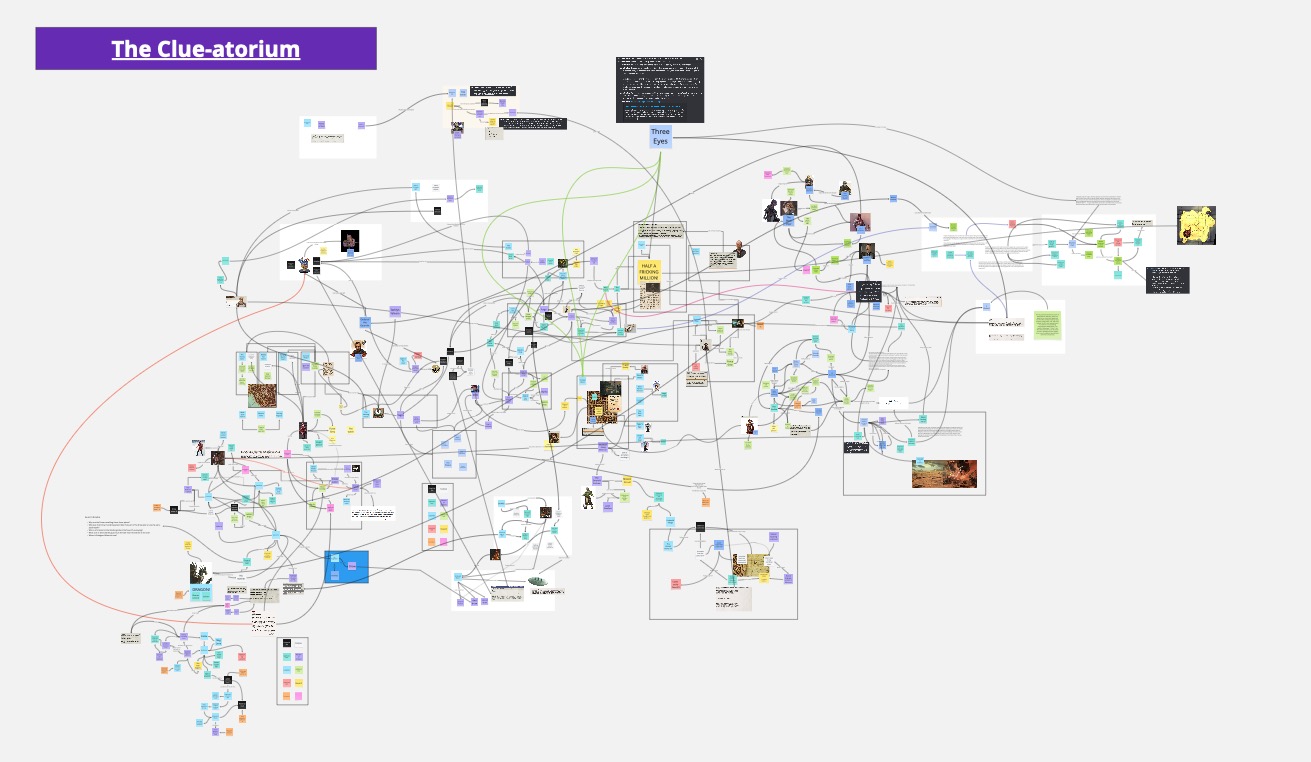
A friend ran the Alexandrian’s remix of the D+D scenario Waterdeep: Dragon Heist in the Pathfinder 2e system. I was playing an investigator so used Miro.com as my conspiracy board. It ended up looking like the attached. Fully sharable and editable amongst a group. It was a lot of fun. (and useful, in that it helped me put together things that I possibly wouldn’t have otherwise.)
Edit to add: you should be able to look around the actual board here: Miro - please be aware it’s chock full of spoilers for the Dragon Heist scenario.