I’m looking for a tactical map, or photographs of a model which are close enough to use it as such, of a 16th to 18th century galiot (half-galley) or brigantine, a small vessel with one or two masts, usually lateen sails, sometimes with one of them square-rigged. The vessel ought to be good for short jaunts to ambush and board trading caravels, cogs and other slower merchant ships, especially if the winds are not favourable for the sailing ship.
All the deck plans I’ve found are for vessels which are too big for my purposes. I want a vessel with just eight oars per side and though I might be persuaded to accept anything up to sixteen oars a side, if no deck plans or models exist smaller watercraft using both sails and oars, I will under no circumstances go higher than sixteen.
The front and rear of our galiot / brigantine can have castles to make it easier to board tall ships, not to mention to fit some artillery there.
Ideally, the crew would be about 65-100 men. 32 rowers, in a perfect world, then officers and some thirty armoured warriors to board any ship unfortunate enough to be caught. There would not be any proper quarters aboard, as the ships would be designed to be anchored overnight or even pulled ashore into a concealed base with dry docks for two of these vessels.
They only go out when they have actionable intelligence about a promising prize and if they need to spend a night at sea, they’ll simply be uncomfortable, sleeping in hammocks set up everywhere and those sleeping on the galley deck more likely to be dry, but the air quickly gets stuffy in there with lots of men there and no motion to create a fresh breeze.
There must be some board game and/or roleplaying game which sells PDFs with various medieval, Renaissance and Age of Sail warships and pirate ships.
A galiot is a like a tiny galley. The galleys at Lepanto could fit up to 600 men in wartime, counting the rowers, but mostly consisting of soldiers to board enemies or defend against a boarding action.
What I want has 65-100 men aboard when crowded with armoured men for a battle at sea. It is like the galleys at Lepanto in the same way that a Kia Picanto is like a Mack 125 6x6 truck.
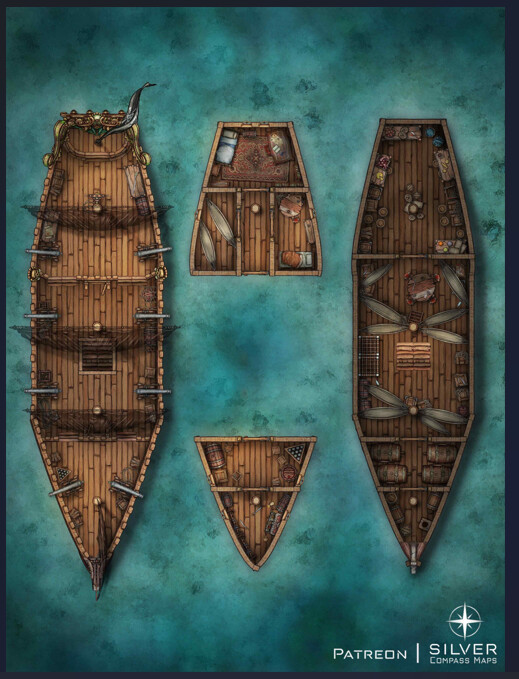
If I’m interpreting the pictures right, the upper vessel doesn’t seem to have oars, which makes the one in the lower picture better by default. It is probably too big, but if each oar is designed for one rower, perhaps not by too much.
On the other hand, having the rowers on top of the half-decked vessel seems… well, counter-productive for a warship. You want them at the waterline and the reason you close your deck, wholly or partially, despite the weight penalty that imposes, is so that you can have an upper deck full of warriors to board enemy ships. Or, you know, just ships which you want to rob, so you treat them as enemies.
When I look at ship models aimed at knowledgeable nerds in the field of ships and sailing, those are nearly always pure sailing ships, with no oars. And if they have oars, they’re bigger than I need. Even though vessels which combined sails and oars were the primary pirate ships on Earth for more than a thousand years and still existed into the Age of Sail, they are very neglected in the model ship world.
RPG square or hex maps are much worse, because those are not just the wrong types, but often show watercraft which would not be capable of doing anything useful. Just as with armour and weapons, there seems to be a tendency to allow ‘artists’ to draw what they like, no matter whether that would or could work at all in the real world.
Maybe that is at least partly because art comes after the playtest phase. So, anything that is wrong in the text has an excellent chance of being intercepted by a literal dozen or so nerds, but fewer, if anyone, review artistic contributions from the perspective of whether it accurately represents anything.
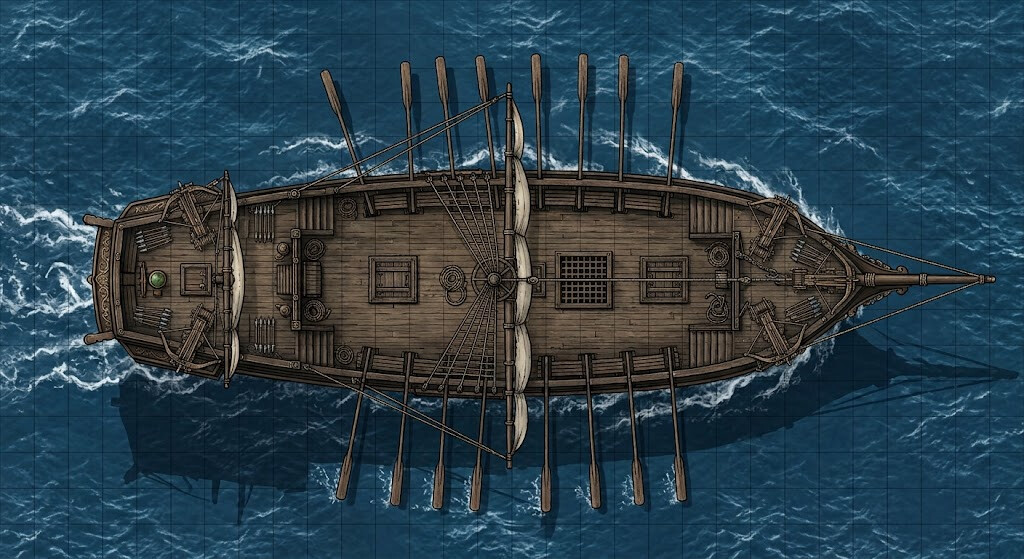
For a setting with 16th century shipbuilding, even up to 17th and 18th century in places, but no cheap natural black powder, only an alchemical substitute made from magical components, this looks like a fairly likely pirate ship. Uses mechanical artillery and sails as primary propulsion, with oars as a backup. Decked sailing ships which used oars when becalmed actually did sometimes use them from the upper deck, especially if leaving holes in the sides would have made an otherwise seaworthy sailing vessel too prone to take on water.
It’s still too heavy for the role I want, i.e. narrow-bodied tiny war galley with a half-deck, leaving it light enough to manhandle up a coast in an inlet cove on a small island, storing it in a shed when not in use. They’re meant to be launched upon receiving a message that prey is being herded toward them and be loaded with so many warriors that they’d run out of drinking water if they had to stay on the water overnight, never mind having no place to sleep and no supplies to eat.
The pictured vessel is likely to be called a brigadine and be the primary warship for a successful pirate captain. You could carry maybe 100 men in this for cruises of several days, even weeks, but if you were hunting and had good reason to expect nearby prey, it would fit 150+ men. None of whom would be full-time rower, that would be a shred chore for becalmed conditions, just as the entire crew spelled each other on the pumps. They’d all be boarders, though maybe 30-50 of them would need to know seamanship as well, so you’d have a prize crew as well as enough unwounded surviving seamen to sail your own vessel home.
You know you don’t have to give me a lecture every time you answer? I’ve studied maritime history from ancient Roman times up to the use of steam (loses it’s attraction too me then) so I’m quite aware.
I was just providing you with as close as i could find
Well, your picture more or less matched the requirements I gave, but not all the ones which the NPC in the setting was using to choose his chase vessels. So I thought I had better explain better what I was looking for and why.
Everything posted in a thread might be read by a hypothetical third party and it would clearly benefit me if such a person knew exactly what kind of vessel I needed and why. So, even if I somehow knew you had a degree in archaeology or history, I would still need to define the tech level of the setting, its supernatural limitations, and give the context I did not give in the first post to explain why an otherwise suitable pirate vessel with eight oars per side and two masts for sails was too broad-beamed and therefore too heavy.
It is possible there is too much detail in my post, but any message that is not a private message is expected and intended to be read by anyone who comes across the thread. Assuming everyone who will read something has a relevant degree is more likely to fail to communicate adequate detail to all potential readers than risking that those readers who are experts will consider the explanations unnecessary.
At this point, why not just make it up? Nothing you find or anyone provides is an exact match for what you want. Take the closest and modify it to fit your needs. This is for an RPG, not a technical manual.
I can’t draw, either by hand or using any digital art tools.
I can write down the number of oars and number of rowers, the length, beam and draft of the vessel and I ought to be able to roughly guess at the weight based on the thickness of the hull timbers and deck, as well as a hypothetical castle if the weight budget allows for one. Odds are, though, if these vessels appear ‘on screen’ in my campaign, PCs will be fighting them, which means it’s quite likely that a PC or more than one boards one and fights on the upper half-deck.
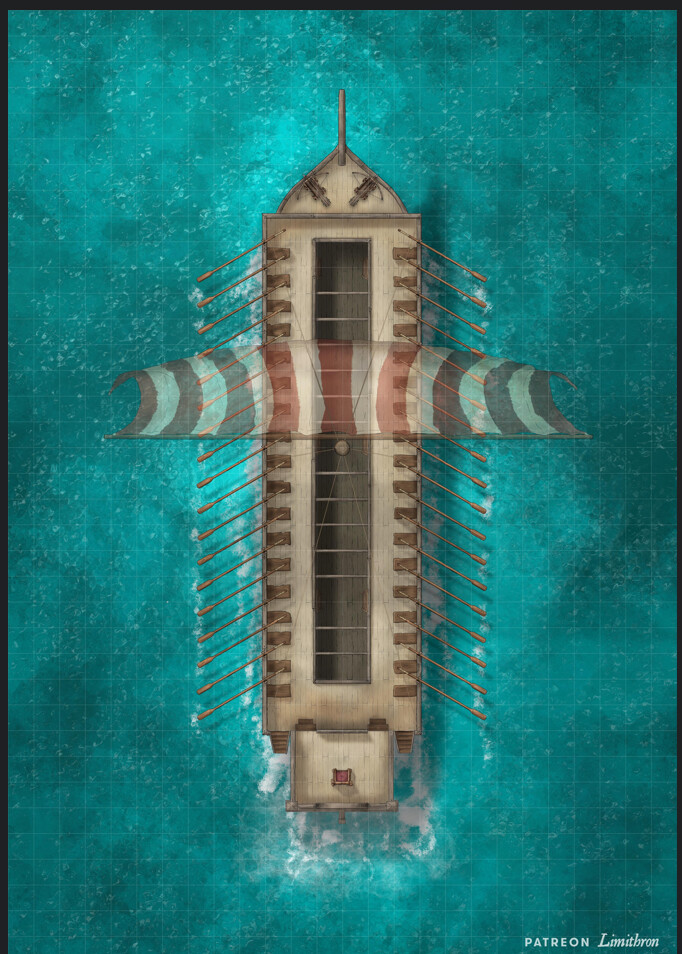
Take this image, print it out, grab scissors, remove two or so seats of rowers, then tape the remainder together. Boom! You’ve got the map of the upper deck of your ship.
It’s a game. Unless your players are nautical historians to the degree they can’t let the smallest incorrect detail slide, nobody will notice or care if it’s not perfect.