Key initialism is FSO, “free space optical”. Free-space optical communication - Wikipedia has discussion on ranges.
Ok, so what commercial-off-the-shelf component did you need to set up a data link within those ranges? Were there laser transmitters and some kind of receivers sold in 1990? To find an any idea of prices, I need to know the terms used for each component which someone might buy in 1990 to set up this kind of data link.
Sorry, all the projects I was familiar with (mostly in 1998-1999) were using custom constructed hardware. There was in theory stuff you could buy, but it cost way more and didn’t seem to work much better.
In terms of skills, Electronics Repair (Communications) can put together a communications device if the character is familiar with free space optical technology and has blueprints or someone instructing them who knows a design for it. Scrounging might substantially reduce material costs, by being able to repurpose various hardware formerly used for other purposes,
Coming up with a new design, instead of making a slight variation something someone else designed, probably calls for Engineer (Electronics), right? Or is there some other skill you’d think the people who did thid likely had?
Well, this is where the design-build/repair-operate triad doesn’t entirely model reality.
Engineer (Electronics): I will design an entirely new laser communications module.
Electronics Repair (Comms): I will put together components to a plan.
Somewhere in the middle: I will put together components that I already have, not designing any new components, starting with someone else’s plan but putting in some variants of my own.
I think that’s probably more ER(Comms) than E(E).
Well, if you are just making a variation on someone else’s design, you don’t need Engineer (Electronics), by GURPS as written. So I think the rules work well enough.
If you want to improve on their design, you do need Engineer (Electronics), but it’s not just licensed engineers who have that skill. Tinkerers functionally have Engineer in the field they where they tinker with designs for the purpose of improving on prior ones, just raising it from a default, usually with an Optional Specialization, and sometimes with the Hyper-Specialization perk or a Technique to cover just the narrow field where they are experts at Electronics Repair.
The difference between the actual engineer, aside from them having more theoretical knowledge than practical hands-on skills, and the hobbyist or technician who play around, working to improve on designs, is usually that the engineer has spent 8 points or more on their Engineer specialty and often many points on related fields and Mathematics. The guy with lots of points in Electronics Repair might only have spent 2-3 points on Engineer, hell, maybe just the one point.
You can even use the perk Skill Adaptation (Electronics Repair for Engineer (Electronics) when making small variations and incremental improvements of an existing design).
With the computing technology of 1990-1991, could digital programs which could equal or exceed the analog targeting computers of various artillery of the 1980s be run on a portable computer?
What equipment would you need to give you the right input? You’d need pretty good range estimates and a laser rangefinder would be ideal, but not necessarily indispensable. I’m not sure to what extent you could work with maps on digital form, as I don’t know in what format geographical or geological surveys and mapping was done. Would oil companies be using computer models of the area they were surveying or would it be done with physical maps?
Navigation equipment, for knowing where you are and where an artillery strike is being requested, would be absolutely indispensable. Without GPS, I suspect that inertial navigation would be the only viable option, but I’m not sure. Perhaps radio beacons at predetermined locations would assist mobile forces in pin-pinting their exact location, with direction-finding antennae and triangularization.
Communications goes without saying, but would voice radio be the only option there, or could a data link to transmit more information than could be quickly conveyed with voice communication over radio, from headquarters to forward observers and batteries or vice versa, add anything useful at that level of technology?
Almost certainly. Even if procurement was honest, the artillery computer is designed to stand up to being used near artillery, and someone did a tradeoff of precision versus cost and fragility.
Haven’t found a good photograph, so this is one of mine. This is what many people will still think of first when they hear “artillery computer”.
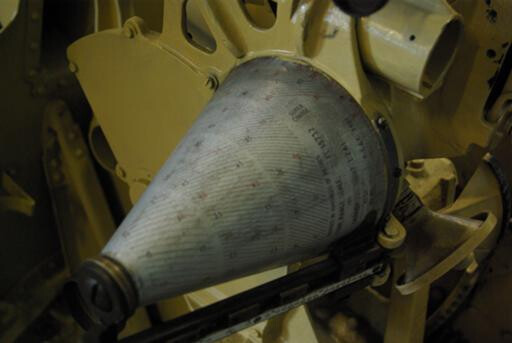
By 1990 laptops are a distinct product category. Compaq and IBM and HP and even Apple are making them. (Battery life is the huge problem, though.)