Agreed. And yet I have some recipe books with prep photos included, and have seen photos of “a pinch” of some spice or another which is wildly more than anything I would have described in this way.
Of course it’s very possible that the author of the recipe was not the photographer and had no direct involvement in the photos and quantities portrayed – but if the person arranging the photos used the wrong quantity because the author of the text had failed to say how much of it to use, that’s just the original problem in a different context. And if the reader is unsure of the vague description and there’s a photo, they’re going to go by what the photo shows.
Mostly I’d start cautiously and add more to taste if I thought it needed it, but with the fennel seeds (which I’d not used before) I wasn’t going to get the full effect until the cooked ingredients were blended, and I needed to take a guess up front. I guessed very wrongly!
I would always take ‘a pinch’ to mean exactly what it says. Grab some between finger and thumb. Exact amounts don’t matter - cooking is an art more than it’s a science - but if they want you to use as much as a quarter of a a teaspoon they can say ‘a quarter of a teaspoon.’
‘A pinch’ means ‘some, but not enough to measure.
If you have a cookbook that reckons a pinch is even half a teaspoon (never mind two!) then you’re gonna need a better cook book.
And if you find a ‘pinch’ hard to quantify, I imagine you struggle with ‘a knob’ of butter…?
My peave about this sort of thing is tv cooks who say “add a tablespoon of oil” while they are on camera clearly pouring much more out of a bottle that’s going “glug, glug”.
It can literally always be measured, though. You just… measure it. Then you write that.
Poisons aside, I don’t think you could add a quantity of any ingredient which was “too small to measure” without it also being too small to have any appreciable impact on the recipe. That would seem more like homeopathy in a chef’s hat.
I don’t actually mind what they mean by it, so long as they say explicitly what that is :).
Heh. That one just seems easier to manage – variations on the size of the knob of butter likely won’t have a massive impact on the result, whereas the effect of spice quantities can be a bit more dramatic.
This explains how I always need to use more oil … a tablespoon is never enough oil for my big stainless steel pan. My bottle also goes brrrrrrh, uh I mean “glug glug”
Actually the right amount of heat and oil makes it possible to fry eggs in my cast-iron, or do whatever I want in the stainless steel without using a PFAS infested pan. But it took me many iterations on teflon et al pans to finally get rid of them forever.
One of the reasons I never cook a recipe for guests for the first time. You never know quite how a recipe behaves until you have practiced it at least once.
I am usually fine with weird or less than precise measurements.
But some recipes omit things like water in the ingredient list and then it’s added in the text. Or sugar is split into two portions and one is added here and the other there. Also timing. Why can’t you just state the needed time summed up at front? Why 10 minutes here, 5 minutes there, and then lots of text and at the end another 30 minutes hidden from the casual cook… and voilà food is late to the table.
Too small to measure precisely in a normal kitchen, I mean. Of course you can measure absurdly small amounts with scientific equipment, but most normal cooks at home won’t have a measure smaller than a quarter of a teaspoon. If that. Hence the existence of the term ‘a pinch.’
Sure (albeit my set goes to an eighth), but the only person who actually needs to make a precise measurement is the author of the recipe. If they say 1/16tsp and my smallest at home is 1/4tsp, I can estimate 1/4 of that with a very strong degree of confidence that I’m in the same ballpark as the author.
And if I conclude that that amount would be “a pinch” for my hands, I can choose to use my hands when I see that measurement in future. And if some other author writes 1/8tsp instead of “a pinch” because they have big hands, I’ll not be short by 50% because I’ll know what they actually mean. And if an author has “a pinch” in mind, but in practice they’re using “a big pinch” (but to them it’s still “a pinch” even if it’s different to what they’d call “a pinch” of a some other spice), none of those variations matter if I get to read “1/4tsp”.
I do appreciate the reasoning behind “a pinch” being common, but I am absolutely convinced (in the observed absence of consistency between authors) that it would be much better if everyone provided actual measurements.
Side peeve: the US tendency to use volume rather than mass measure. The reactive quantity of an ingredient is the mass, and when it’s powder the density can vary by a factor of 1.5 or so just from storage, never mind different manufacture. This is why people think baking is uniquely hard.
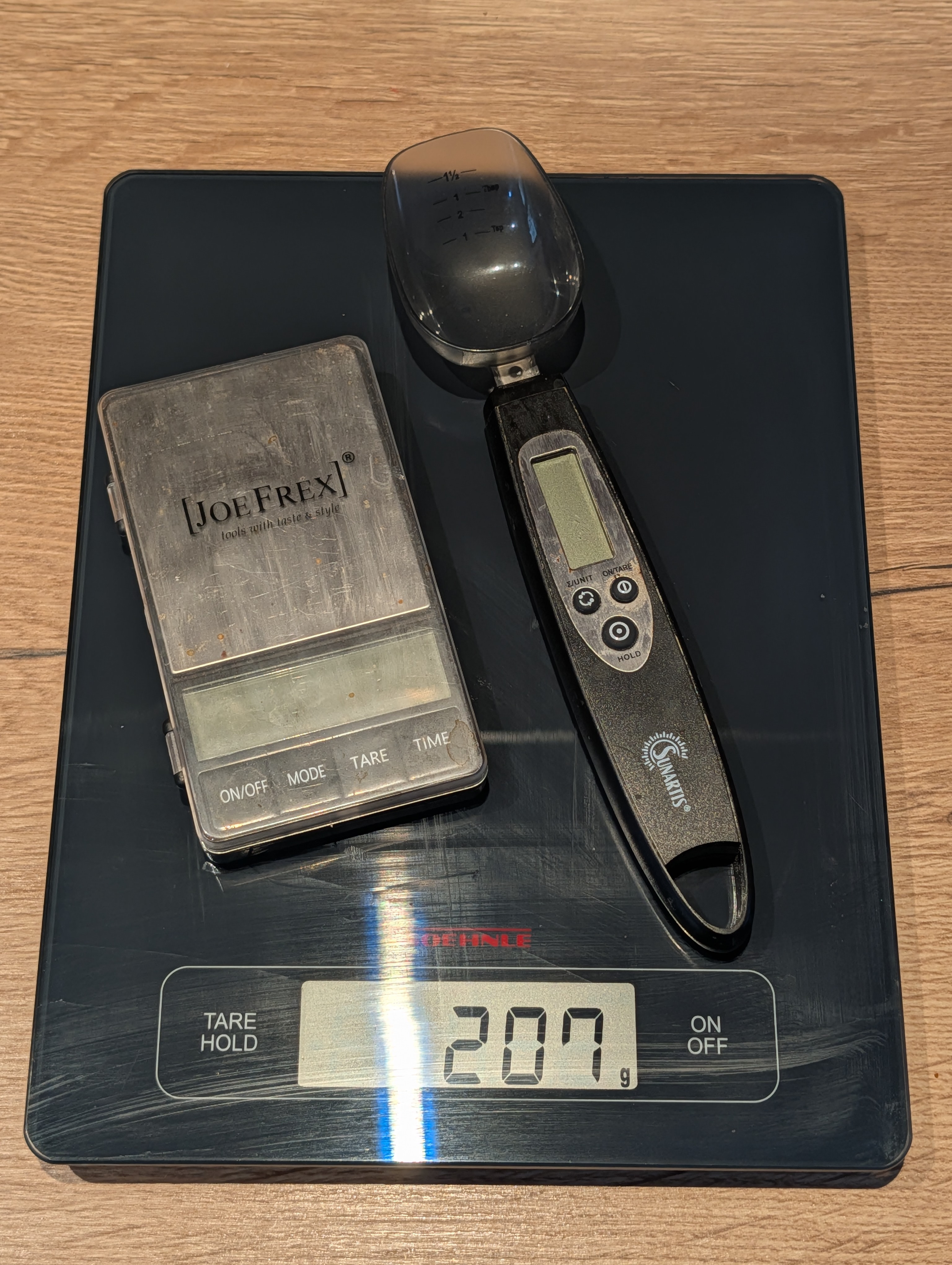
I have three sets of scales in my kitchen.
The big one is the “standard” kind, I use it for measurements from 50-2000g .
The spoon is for bread-baking and it weighs as low as 0.1g which is needed to add minuscule amounts of fresh yeast to some sour dough recipes
The third is for coffee. We want about 18g for 2 espresso from our big machine… and that one also goes down to .1 grams. Our grinder needs 12.2 seconds to grind 18g currently. This depends on the beans and how we want our coffee ground and–sadly I found out–how clean the grinder is
Some years ago, I bought a small scale that measures 0.01gx100g from amazon, to measure spices with. For months after, they were convinced I needed to stock up on very small ziplock baggies.
@RogerBW things in the US have improved a lot about that. When I started baking, in the previous era, the only recipes that had weights were foreign ones, and ones intended for professionals[1]. One of my first bread books was the UK version (It was on the discount table at some bookstore), and it gave weights for everything. (and oven temperatures in something callled “gas ring”. WTF.) So I bought a digital scale, because it made sense. These days, most recipes have weights available. (sometimes, wrong ones, but that’s a different rant).
[1] In a truly bizarre system known as baker’s percentages, which warms my applied mathematician heart. You can give someone a recipe without any actual measures!
yeah, for a while there was a specific brand of cooker for which this was useful, and others copied their numbering. It’s actually two separate linear scales, above and below 1 (hardly anyone used the “below 1” part).
Those are important because from the percentages you can make any amount of bread. And baker’s kind of need to be able to scale…
Oh I wish I had the “time” to make my own bread these days. We’ve been living of bakery bread for months. My sourdough starter is still alive though and I hope that sometime soon, I’ll find the energy to make my favorite rye sourdough–the one with the fennel seeds (the other two spices are caraway and coriander seeds) @Phil
The actual recipe says to use .2g for each of the 3 spices. Instead, I am using a “good” pinch (grab the spice with 3 fingers) of each because I like the stronger taste. In my estimation about 3x the amount originally asked for. It has worked well for me so far. I still measure the yeast with the spoon-scales, though I often use a tiny bit more depending on how well conditioned my sour dough starter is.
Baking only needs precision until you have a “feel” for the recipe … this is how I want to play Take Time, too. Just my partner likes really precise recipes (except when he doesn’t)
 … this is how I want to play Take Time, too. Just my partner likes really precise recipes (except when he doesn’t)